
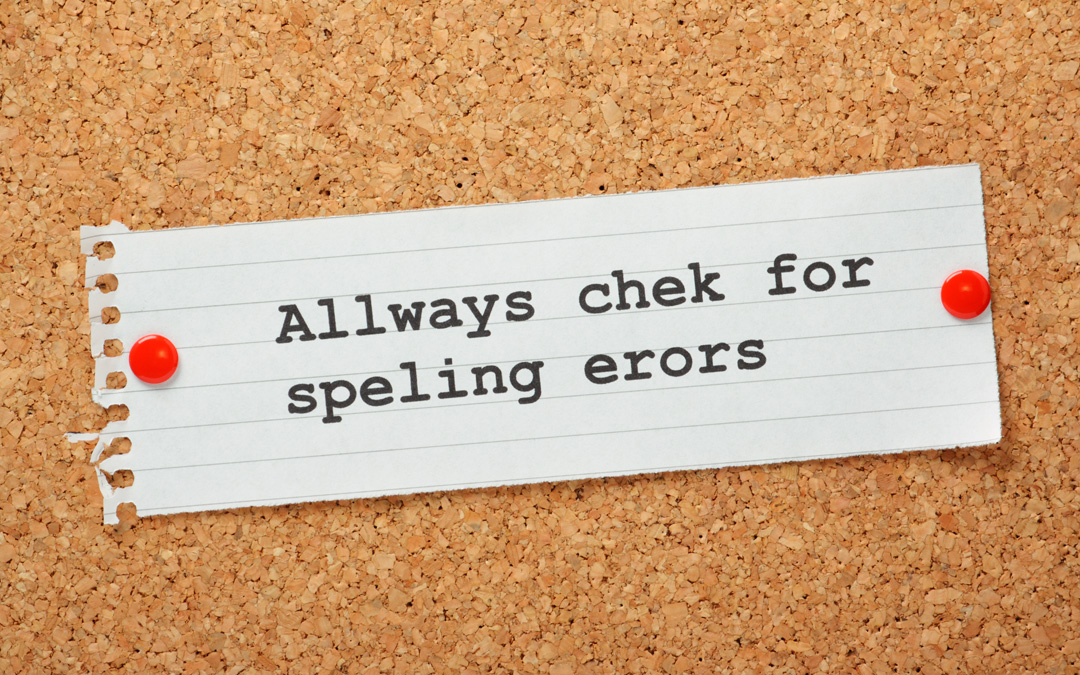
You would be amazed at the number of simple spelling mistakes I find missed by authors and spellcheck. These word crimes are due to Homophones. Homophones are words that sound the same but have different meanings and spelling. They go undetected because the spellchecker is looking for misspelt words; not misused. If you are using an editor, catching these word crimes will save your editor time, and you money.
Why do we make basic spelling mistakes?
It’s down to how our brains work. Historically, imagination and creativity were thought to be right brain functions, and logic, maths, and language left brain functions working independently. We now know that this distinction is an over-simplification of the many complex cognitive processes that the brain performs. While a writer focusses on bringing form to their imagination the more mundane tasks of placement of commas and whether it is ‘to’ ‘too’ or ‘two’ are put on autopilot to free up space for the creative project.
We also read with the expectation of what we will see.
“It deosn’t mttaer in waht oredr the ltteers in a wrod are, the olny iprmoetnt tihng is taht the frist and lsat ltteer be at the rghit pclae. The rset can be a toatl mses and you can sitll raed it wouthit porbelm. Tihs is bcuseae the huamn mnid deos not raed ervey lteter by istlef, but the wrod as a wlohe.”
As your brain deciphered each word in the example above, it also predicted which words would logically come next to form a coherent sentence.
“We are continuously anticipating what we will see, hear or feel next,” Dr. Lars Muckli, a researcher at the University of Glasgow’s Institute of Neuroscience and Psychology.
With training and a bit of practice this bias can be mastered. Here are some of the most commonly misspelt homophones. Click here to get a list of 460 common Homophones. Swift use of the ‘Find’ function in Word will quickly get results.
They’re Their and There
- There is a contraction of they are.
- Their refers to something that belongs to ‘them’.
- And there is simply ‘a place.’
Example: They’re going to their car, which is over there.
You’re and Your
- You’re is a contraction of you are.
- Your refers to something that belongs to the person you’re speaking to.
Example: You’re going to be late for your supper.
To, Too and Two
- To is a preposition that shows direction or can mean ‘until’.
- Too can be used in place of as well or also but can also imply something is extreme or excessive
- Two is a number that comes after one.
Example: ‘The two of them are going to the beach too.’ ‘It’s too hot!’
We’re, Were, Where and Wear
- We’re is the contraction of we are.
- Were is the past tense of are.
- Where refers to a place
- Wear refers to clothing or having something on your body as clothing, decoration or protection. It can also refer to something becoming weaker, damaged or thinner with continuous use.
Example: ‘ Where are you?’ ‘We’re where we were when we were wearing our new outfits.’ ‘I always wear a hole in the elbow.’
Then and Than
- Then is a point of time
- Than is a method of comparison
Example: Then she said, ‘I love Corsica. I would rather be there than here.’